
The Jamming Failed
Six Days Over Barksdale: What the Official Statement Left Out
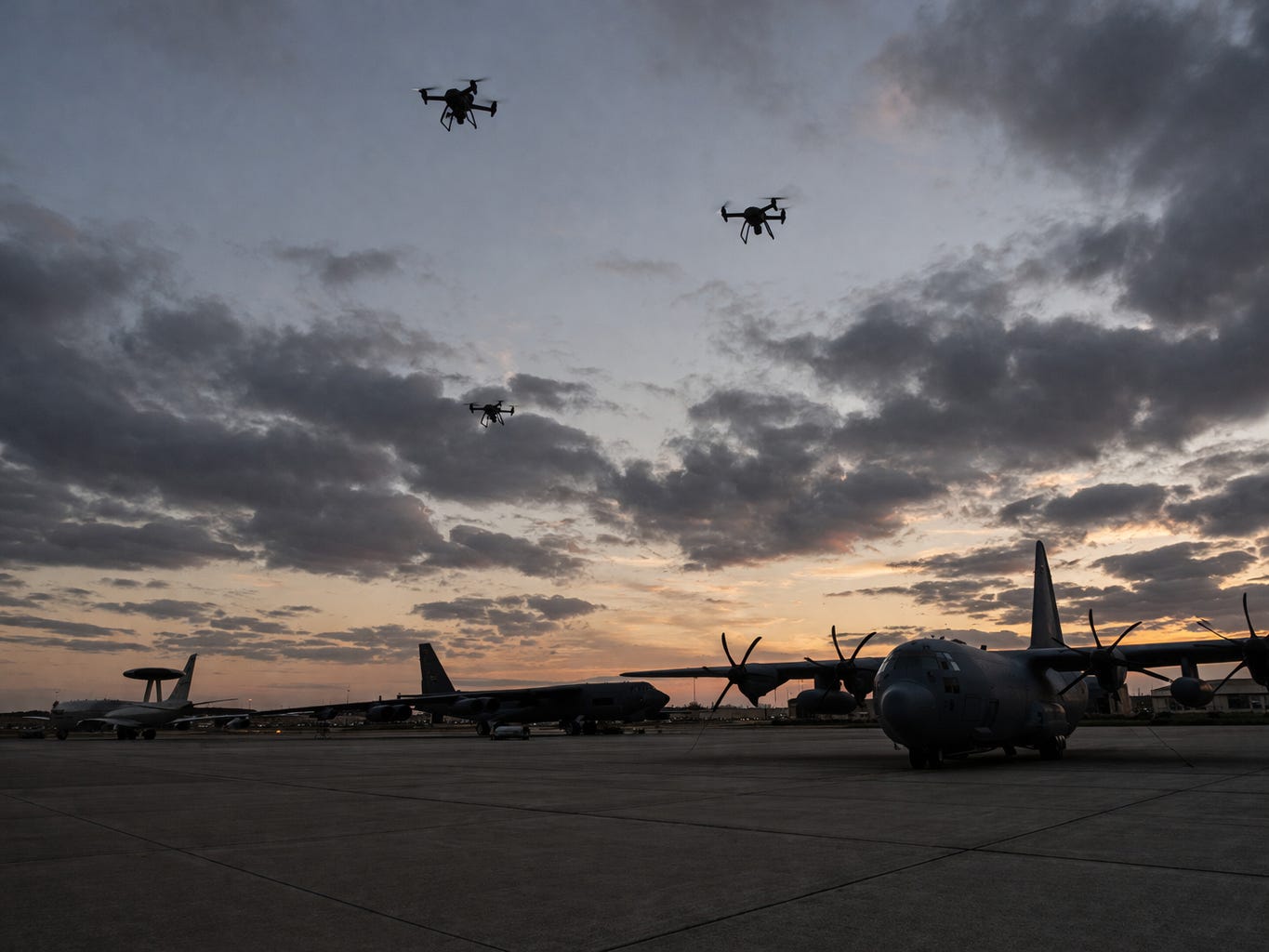
Nine days into the Iran bombing campaign, drones appeared over Barksdale Air Force Base.
Not one drone…waves of them. Twelve to fifteen aircraft per wave, running four hours a day, focused specifically on the flight line where the B-52s sit.
The base issued a shelter-in-place order on March 9. Flight operations halted. Then the order lifted and the drones came back the next day. And the day after that.
The military didn’t say a word publicly for eleven days.
When they did say something, on March 20, Capt. Hunter Rininger confirmed “multiple unauthorized drones” and said they were working with law enforcement. No arrests. No attribution. The FAA deferred all questions to the military.
I want to be clear about what this actually was before we get into it.
The part the coverage buried
A confidential Air Force briefing from March 15 got leaked. Air and Space Forces Magazine and a few others reported on it.
Here’s the detail that should have been the headline everywhere:
The drones were resistant to jamming.
NORTHCOM had deployed its counter-UAS Flyaway Kit to the base. Anduril-built system, includes electronic warfare capability and kinetic interceptors.
This exact kit was used successfully on February 28, the opening day of Operation Epic Fury, to neutralize a drone threat over another strategic installation.
At Barksdale, the jamming didn’t work. Six days of drone activity, electronic countermeasures deployed, and the drones kept flying anyway.
That’s not in most of the coverage.
Here’s why it matters.
Jam-resistant drones aren’t something you build in a garage. This isn’t a modified DJI Phantom with a software tweak.
The anti-jamming capability described in that briefing, combined with non-commercial signal signatures, long-range control links, and custom construction, puts this in the category of state-level or state-supported hardware. Significant engineering. Significant resources.
Operators who knew what countermeasures they were going to face and built for it.
This isn’t the first time this playbook ran
October 31 through November 2, 2025. Kleine Brogel Air Base in northeast Belgium.
Three nights in a row, drones over the facility.
Kleine Brogel stores B61 nuclear bombs under NATO’s nuclear sharing agreement. The Belgian defense minister described what happened in two stages: small drones first, probing the base’s radio frequencies, mapping the electronic signature of the security systems. Then larger drones operating over the facility itself.
Read that again and then look at Barksdale.
Probing runs. Frequency mapping. Multi-day sequential waves. Deliberate maneuvering to avoid having operators direction-found. Swarm saturation of a defended perimeter. The methodology is nearly identical. And nobody publicly connected those two incidents until now. The Kleine Brogel story barely got coverage in U.S. outlets.
Two NATO nuclear sites. Same playbook. Less than five months apart. That’s not a coincidence.
What four hours over a flight line actually gets you
A fly-over gives you a snapshot. A four-hour loiter gives you an operations picture.
Five active days of 12-15 drones over Barksdale’s flight line, focused on where the B-52s are positioned and prepped for missions, gives you enough time to map aircraft parking positions, document maintenance crew shift patterns, watch fuel and munitions loading sequences, track security response times, identify patrol routes, and find sensor blind spots. That’s targeting intelligence.
One more thing on the visible lights. Most serious reconnaissance platforms run dark. There are two reasons you’d operate with lights on over a restricted military installation.
You’re testing how fast security responds so you can map their coverage. Or the lit drones are the visible layer of a two-layer operation, drawing attention up while something quieter and higher runs the real collection.
Either way, it’s deliberate. That’s not how a curious hobbyist operates.
The timing
Barksdale isn’t just a B-52 base. It’s the operational hub for strategic bombers running combat missions under Epic Fury. Aircraft were launching sorties over Iran during the same week someone was mapping the flight line.
That timing has a name. It’s called wartime reconnaissance.
If you want to know what a base looks like when it’s surging, how many aircraft are launching, what the preparation tempo looks like, how crew patterns change under operational load, you watch it during active operations. Not peacetime.
That’s when the information is current and actionable.
Nobody has attributed this publicly. FBI, Louisiana State Police, and federal agencies are all investigating. No responsible party named.
I’m not going to name one either.
What I’ll say is that the anti-jamming capability and the coordination required to run multi-day swarm operations over a defended military installation during active U.S. combat operations narrows the field considerably.
What to do with this
Barksdale has NORTHCOM support, Anduril hardware, 2nd Security Forces Squadron, and the full resources of the U.S. military. Their jamming failed.
Your water treatment plant has a chain-link fence.
That’s not meant to alarm you. It’s meant to orient you to where we actually are on domestic infrastructure defense against small UAS threats.
The gap at Barksdale isn’t an anomaly. It’s a preview of what most critical infrastructure faces with zero dedicated counter-drone capability.
Stop waiting for mainstream coverage to tell you when something significant happens to domestic infrastructure.
The Barksdale incursion ran six days before it was publicly confirmed. Kleine Brogel barely made U.S. news.
Watch what agencies aren’t saying.
The FAA deferred everything to the military. Multiple agencies went quiet simultaneously.
That’s information.
Know what’s near you.
Military installations, power generation, fuel terminals, communications infrastructure. Not because you need to worry about it every day, because proximity to strategic assets changes your risk calculus when the threat environment shifts.
Watch for follow-on incidents.
The leaked briefing expressed high confidence that similar incursions could continue in the near term.
If that assessment is right, and I have no reason to think it isn’t, this story isn’t over.
One last thing.
NORTHCOM Commander Gen. Gregory Guillot testified before Congress around March 17-19. He described what happened at Barksdale as a “small drone incursion.”
Twelve to fifteen drones per wave. Four hours per day. Five active days. Jam-resistant. Over a nuclear bomber base in the middle of a war.
Small.
Someone decided that’s the word the public should use for this.
I’d think carefully about what else is getting the same treatment.