
The PDW Gap: What That Viral MP7 Photo Reveals About the Hole in Your Defensive Setup
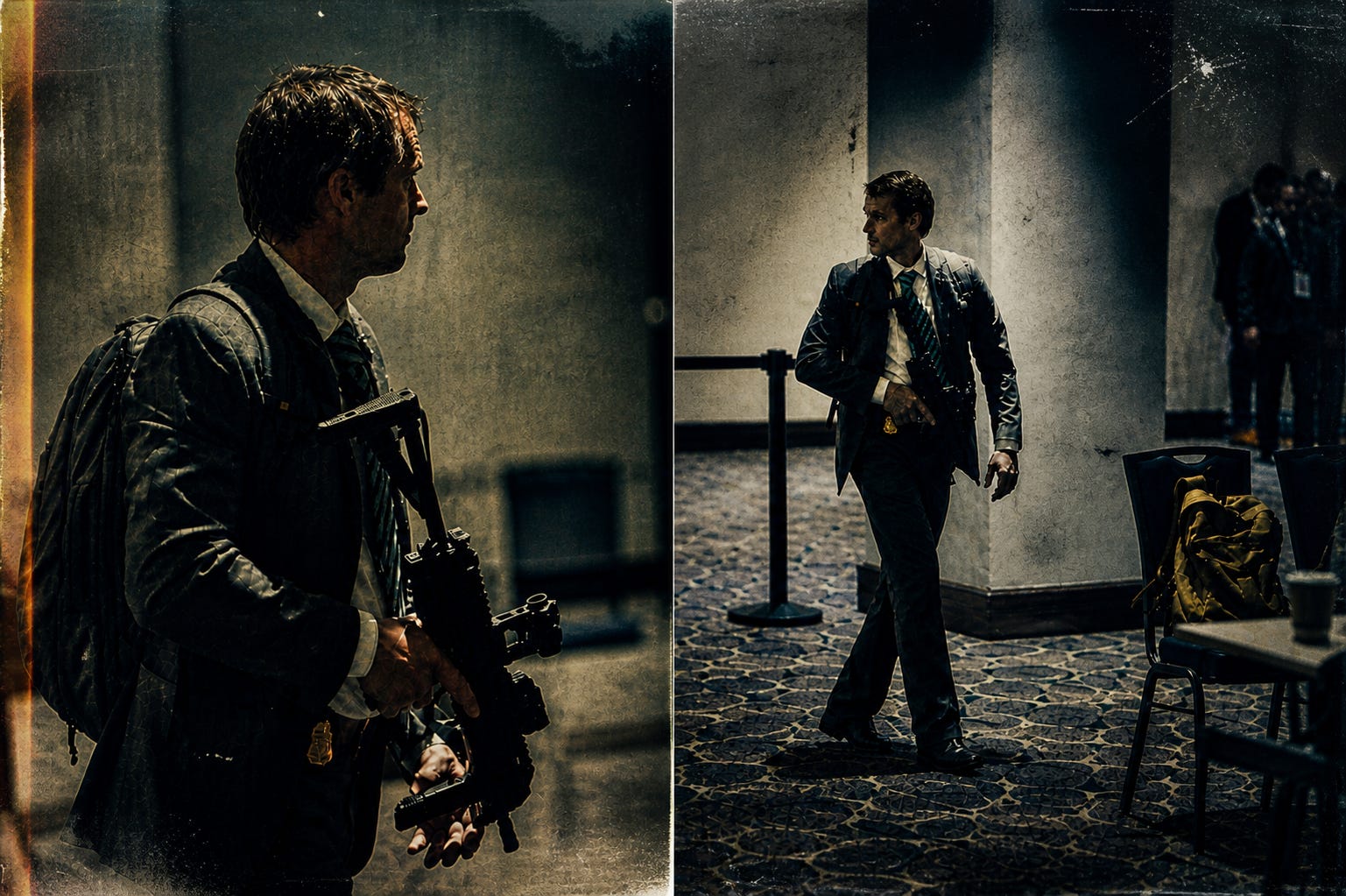
You probably saw the photo. Tailored suit, Crye Precision backpack, expressionless face.
In his hands: an HK MP7 personal defense weapon, Aimpoint T2 on a Unity FAST mount, SureFire XVL2-IRC forward, collapsible foregrip.
The agent deployed it during the April 25 breach attempt at the White House Correspondents’ Dinner after Cole Thomas Allen showed up to the Washington Hilton with a shotgun, a pistol, and knives.
The internet lost its mind, and I get it. That is a genuinely impressive piece of kit, deployed by someone who looked like he knew what he was doing.
But the part that most of the gear conversation missed is more interesting than the MP7 itself.
The question worth asking is not “what is that gun” but “why does that category of gun exist at all, and what does the answer mean for you.”
The MP7 belongs to a weapon category called the Personal Defense Weapon, or PDW. The category was “invented” to solve a military problem that nobody had a good answer to.
In the early 1990s, NATO identified a gap in their force protection. Rear-echelon troops, logistics personnel, vehicle crews, artillery teams, support staff, were issued pistols.
Pistols are better than nothing. They are not much better than nothing against a threat wearing body armor.
A rifle solves the armor problem, but is impractical for troops whose primary job is not shooting: it is bulky, it gets in the way, and most of these personnel are not rifle-trained to a level where the added length and weight actually translates to capability.
NATO’s answer was to define a new requirement: a weapon small enough to carry like a pistol, firing a round specifically engineered to defeat soft body armor at ranges out to 200 meters.
The result was the PDW category, and HK built the MP7 while FN built the P90. Both chambered proprietary high-velocity, steel-core cartridges designed for exactly this purpose.
The MP7’s 4.6x30mm round was engineered from the ground up to punch through NIJ Level IIIA soft armor, the same standard that covers most concealable vests, while keeping recoil and platform size manageable.
The gun collapsed is about 16.5 inches. Loaded, it weighs under five pounds. Rate of fire is around 950 rounds per minute. The round moves fast enough to defeat armor that a 9mm cannot reliably beat.
That is why the agent at the Correspondents’ Dinner was carrying a tool built specifically for a scenario where a pistol may not be enough, and a rifle is not appropriate.
Now let’s talk about the gear on that specific gun, because it is worth understanding why each piece is there.
Aimpoint Micro T2 on a Unity Tactical FAST mount.

The T2 is one of the most trusted red dots on the market for serious use. Battery life is measured in years at normal usage. The lens coating is excellent in low light.

The Unity FAST mount raises the optic high enough that you can get a natural cheek weld on a folded-stock PDW or SBR without craning your neck. That matters when you are deploying a compact platform from a non-standard position under stress.
SureFire XVL2-IRC.

This is a combined white light and infrared laser module. The white light handles positive target identification in low-light environments.
The IR component is for use with night vision, which plainclothes federal protection details carry more often than most people assume.
Running IR in a hotel ballroom seems like overkill until you realize these agents work across wildly different environments, and a single configured weapon beats carrying multiple setups.
The Crye Precision backpack.

This is the piece most people glossed over in favor of the gun. Crye Precision builds gear for people with specific operational requirements and the budget to solve them.
The EXP-series pack has an internal configuration that allows a compact long gun to be staged vertically for a rapid one-handed draw. The exterior looks like a professional’s commuter bag. That is intentional, and concealment is the point.
This setup, from the optic mount height to the IR capability to the carry container, tells you this agent is not improvising. Every component answers a question somebody asked before the event happened.
The Civilian PDW Problem
Here is the honest answer most gear content will not give you: civilians in the United States cannot buy an MP7. The platform is not available on the civilian market. The 4.6x30mm round is not something you can stock at a standard dealer.
What civilians can do is apply the thinking behind the PDW to what they actually have access to.
The PDW concept is not about any specific platform. It is about identifying the capability gap in your defensive setup and finding the right tool to fill it.
For a NATO rear-echelon soldier, the gap was “my pistol won’t stop an armored attacker.” For you, the gap is probably different.
Most civilian defensive setups look like one of three things: a carry pistol, a home defense shotgun or rifle, or nothing.
The gap is usually in the middle. A carry pistol maxes out around 15-17 rounds and is accurate to maybe 25 yards/meters in the hands of an average shooter under stress (I know…results may vary). A rifle or shotgun is not something you can easily always have on your person in a public space.
What fills that gap for a civilian is worth thinking through seriously.
At home
The pistol-caliber carbine is the civilian equivalent of PDW thinking. Platforms like the CZ Scorpion, SIG MPX, B&T APC9, or even a good MP5 clone give you rifle-like ergonomics and accuracy, magazine capacities that substantially exceed a handgun, and calibers that run reliably in a short barrel without the overpressure problems you get with rifle cartridges.
They are maneuverable in hallways. They are easier to shoot accurately under stress than a pistol. They share magazines with your carry gun if you run the same caliber.
For home defense, this is the closest civilian analog to what that agent was carrying.
In a vehicle
The PDW concept for vehicle carry in a civilian context is a compact pistol configured for serious use.
That means a quality red dot, the Holosun 507C or SIG Romeo2 are solid (cheaper) options, a weapon light in the 1,000 lumen or above range, and a consistent carry position where you can access it with your support hand if your primary hand is occupied.
Vehicles are confined spaces with limited movement options. Accuracy at speed matters more than it does in a static shooting position.
On your person
This is where the PDW concept most directly challenges civilian EDC thinking. You cannot carry more gun than your environment allows. But you can carry your existing gun better.
A compact pistol with a red dot and a weapon light is meaningfully more capable than the same pistol without either, at the engagement distances and lighting conditions where defensive shootings actually happen.
Adding a spare magazine(s) addresses the capacity gap that separates pistols from PDW platforms. These are not exotic purchases; they are the civilian equivalent of doing a similar analysis that the agent’s unit did before that event.
What to Do
Map the gap in your own setup. Write down what you carry, where you are when you carry it, and what scenarios your current gear cannot handle. That gap is what you need to solve. Do not buy more gear before you know what you are buying it for.
If you do not have a weapon light on your carry gun, fix that first. Positive target identification in low light is not optional. The SureFire XVL2-IRC on that MP7 costs a bit of your paycheck. A SureFire X300 Ultra or Streamlight TLR-1 HL on your carry pistol costs significantly less and closes the single most common capability gap in civilian defensive carry.
Consider a red dot if your pistol will accept one. The Aimpoint T2 on the MP7 exists because a red dot improves speed and accuracy, especially under stress. The same is true on a pistol. It takes training to run well. That is the point.
For home defense, evaluate whether a PCC closes gaps your pistol does not. If you are running a full-size pistol for home defense, a pistol-caliber carbine in the same caliber gives you a meaningful accuracy and capacity upgrade with manageable concessions. It is not the right answer for everyone, but it is worth the analysis. Let’s not forget about those SBR’s….
Train to access, not just to shoot. The agent’s Crye backpack is only useful because he has practiced drawing from it. Whatever your carry setup is, practice the draw from the position you actually carry in, under conditions that approximate the stress you might face. Speed of access is a capability multiplier.
The Edge
The NIJ Level IIIA point is worth sitting with for a moment.
The MP7’s round was specifically engineered to defeat soft body armor at the threat level that is commercially available and increasingly common in mass casualty events. That is the reason the platform exists.
Most defensive ammunition for 9mm and .45 ACP is optimized to expand in soft tissue. It was not designed with armor in mind because that was not the assumed threat. Armor-piercing pistol ammunition is illegal for civilian ownership under the Law Enforcement Officers Protection Act.
This is not a reason to panic. It is a reason to understand what your ammunition is and is not capable of, and to recognize that the professionals who built the MP7 were solving a problem that did not exist in civilian contexts a decade ago and is not yet common now.
The threat environment changes. The gear follows. The best time to understand that sequence is before it matters.