
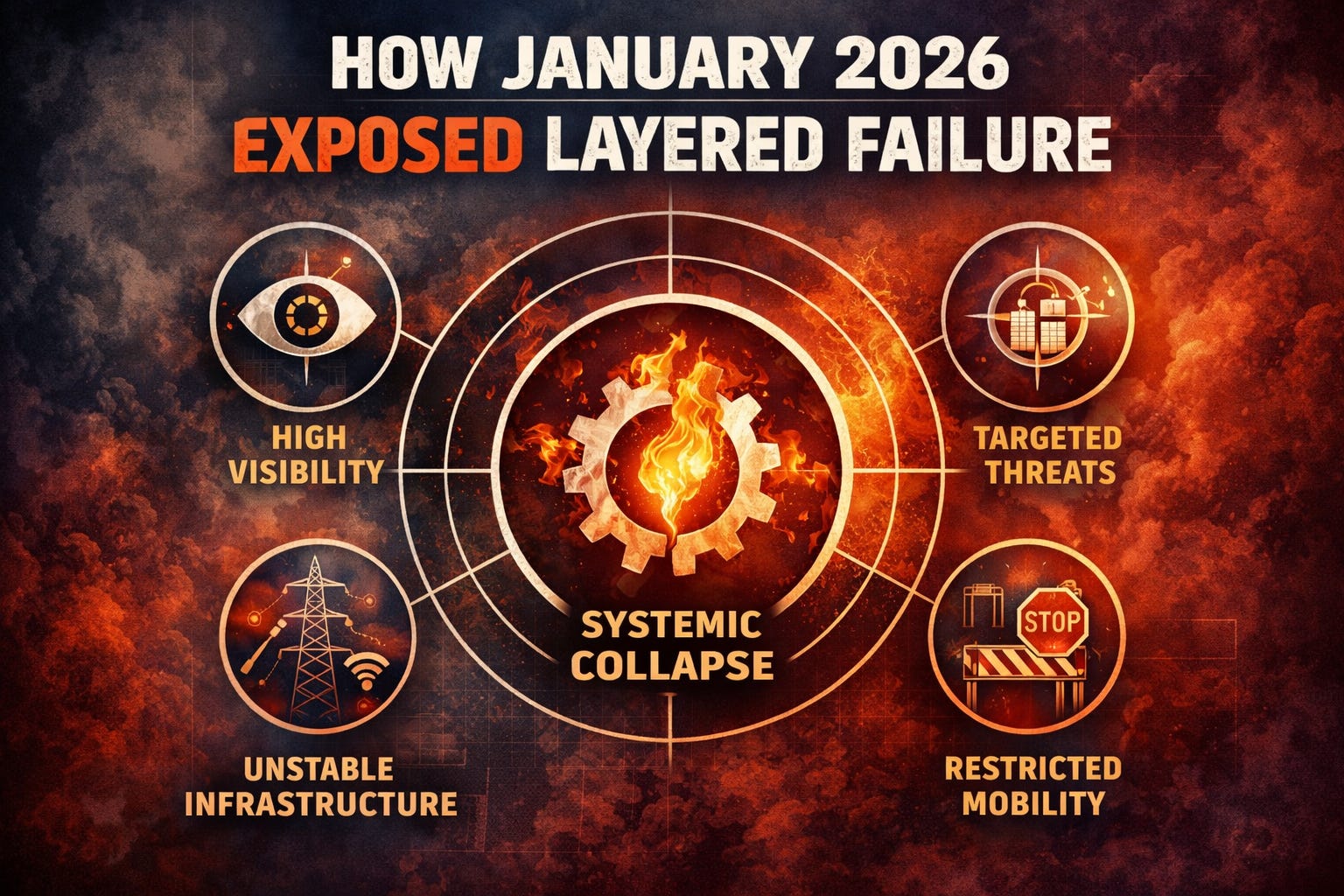
How January 2026 Exposed Layered Failure
In January 2026, multiple critical systems failed simultaneously across the United States.
Power remained offline for extended periods, civilian movement was restricted by weather events, protests, and security perimeters, public venues became contested spaces, and communications networks proved unreliable.
These failures did not occur in isolation.
They unfolded in layers, with outer protective buffers degrading first and inner systems absorbing escalating pressure.
Most civilians did not recognize the severity of this process until their practical options had already narrowed.
This pattern now defines modern disruption. It does not present itself as immediate collapse. Instead, it emerges gradually through friction, delay, restriction, and uncertainty.
By the time danger becomes obvious, most individuals are already operating within constrained conditions.
January 2026 demonstrated this progression in real time.
Understanding the Survivability Onion in a Civilian Context
Military systems are built around layered survivability.
The core principle is simple: survival depends more on avoidance and positioning than on resistance.
This concept is often represented as the “Survivability Onion,” a model in which protection is achieved through successive layers that prevent engagement before force becomes necessary.
Modern civilian life now reflects this structure.
January revealed what happens when these layers degrade from the outside in.
Rather than experiencing a single catastrophic failure, communities encountered progressive loss of autonomy across visibility, mobility, infrastructure, and recovery capacity.
The Five Layers of Civilian Survivability
The Survivability Onion describes protection as a sequence of layered defenses.
Each layer exists to prevent the next from being tested.
Once an outer layer fails, pressure moves inward.
For civilians, the model translates as follows.
Layer One: Avoid Being Noticed
This is visibility.
It includes digital footprint, routines, location exposure, and behavioral signaling.
When this layer fails, individuals and locations become easy to identify and track.
January demonstrated how quickly online visibility translated into real-world targeting.
Layer Two: Avoid Being Selected
This is perceived value.
It reflects how attractive a person, location, or system appears to hostile actors.
Wealth signaling, isolation, and dependency increase selection risk.
When this layer fails, attention concentrates on specific targets.
January showed this through the prioritization of soft and temporary infrastructure.
Layer Three: Avoid Being Engaged
This is mobility and positioning.
It determines whether an individual can avoid contact, disruption, or confinement.
When this layer fails, movement becomes constrained, and autonomy collapses.
Roadblocks, perimeters, and weather closures in January demonstrated this effect.
Layer Four: Resist Penetration
This is physical and procedural hardening.
It includes security measures, barriers, redundancy, and defensive capability.
This layer matters only after previous layers fail.
It mitigates damage but does not prevent engagement.
January showed that hardened facilities without outer-layer resilience still degraded.
Layer Five: Preserve Function
This is recovery and continuity.
It includes power, communications, finances, medical capacity, and social networks.
When this layer fails, disruption becomes long-term dependency.
Households and communities with redundancy in January retained autonomy. Others did not.
How the Layers Interact
The model works from the outside inward.
Failure at one level transfers stress to the next.
Most civilians focus on Layers Four and Five.
January showed that Layers One through Three now fail first.
